
$NFLXOct 2, 2026
Netflix at $68: Buy the Dip or a Stock Being Re-Rated for Good?
Netflix at $68: four valuation phases, the Warner Bros. fee's effect on earnings and cash flow, engagement risks, and what would justify buying the dip.


Staff Financial Analyst
Bylines
Netflix at $68: four valuation phases, the Warner Bros. fee's effect on earnings and cash flow, engagement risks, and what would justify buying the dip.
Micron's September 30 entry decision: four valuation phases, verified contract protections, earnings scenarios, and the evidence needed to justify buying.
EchoStar trades at $95 while UBS values its SpaceX stake at $110 a share. The discount is real, but smaller than it looks, and the tax bill is unpublished.
Intel ran from a $20.47 rescue price to a $142.35 record, then fell to $101. At 51x forward earnings vs. a 24.5x peer median, is a $200 call realistic?

CAH's trailing P/E ran from 16.4x to a 76.5x air pocket to roughly 32x today, while PEG collapsed to 0.35. Here's what's really driving each valuation phase.

FRT's Opportunity Score sits near 100, but that's a six-month rescaling, not a rare discount. Here's what the score, Core FFO growth, and Wall Street's ratings say.

GOOGL hit $4.14 trillion, then lost $225 billion in a day. How Google re-rated from search monopoly to AI infrastructure giant, and whether the price still fits.
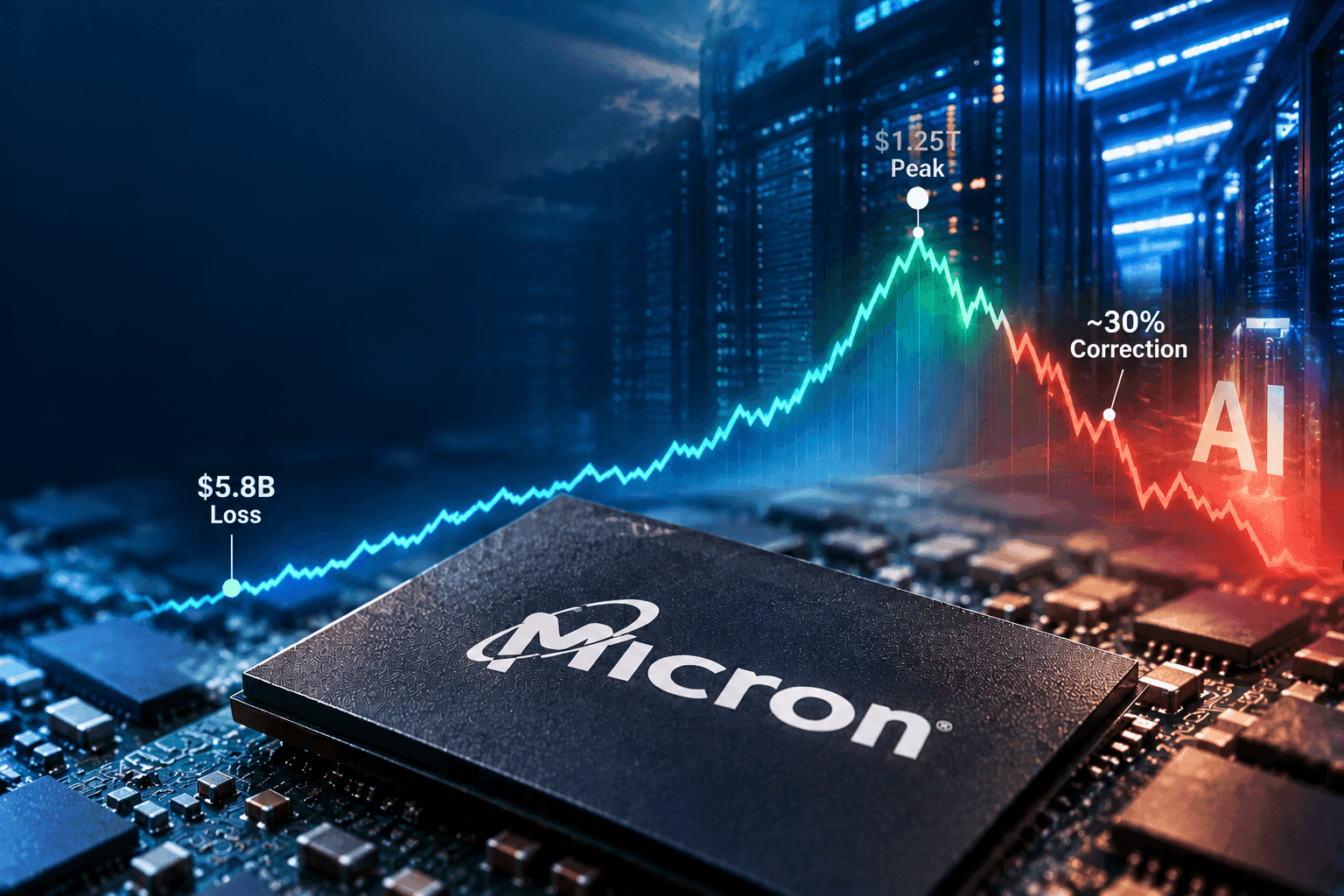
Micron went from a cyclical trough to a trillion-dollar AI stock in three years, then lost 30% on bubble fears. What the three valuation phases say comes next.

Microsoft's fiscal 2026 results show an AI bet that's working on its own terms, but a sold-out memory market, a restructured OpenAI deal, and a Federal Reserve split on rate policy are testing how durable that lead really is.

Carnival, Royal Caribbean, and Norwegian Cruise Line are all down 26%-41% from their 52-week highs on oil-driven, Iran-conflict selling. SPXScore's Opportunity Score and the sector's debt loads tell two different stories about which stocks are actually cheap.
Marvell fell 10% after beating Q2 estimates and raising guidance, as gross margin compression from its custom-chip mix overshadowed a Google TPU deal worth up to $120B and a 53x-180x valuation split. Which side of the AI trade is right?

Nvidia's Q2 FY2027 beat and above-consensus guidance broke a four-quarter losing streak with investors. But the memory costs squeezing its own margins are turning SK Hynix and Samsung Electronics into the AI trade's quietest winners.

Meta's child-safety settlement caps a tail risk that once threatened $1.4 trillion, but a roughly $10 billion charge and new teen-engagement limits complicate the bull case. Here's the valuation math and three explicit scenarios.

CRWD fell 36% after the July 2024 outage, then rallied roughly 255% into a 4-for-1 split. With no trailing P/E to anchor it and a forward multiple near 120x-165x, the stock's premium now rests entirely on Falcon Flex and ARR execution.

Oracle's record $638 billion RPO backlog proves AI demand for its cloud is real, but financing the buildout has pushed free cash flow negative and debt toward junk-adjacent territory. Here's why ORCL keeps pulling back anyway.

CRWV has fallen roughly 54% from its 2025 peak even as its contracted backlog hit $104 billion. Here's how hyper-growth revenue, a 9x-plus debt-to-EBITDA load, and insider selling are pulling the stock in opposite directions.
Nvidia reports Q2 FY2027 earnings on August 26 against a $91.9B revenue bar that assumes zero China data-center revenue. With Q1's $48.6B free cash flow and a $309 consensus target, is the 50% upside case grounded in cash, or in hype?
Treasury doubled its bond buyback caps to $4B per operation after the 30-year yield hit a two-decade high. Here's what it means for stocks.

WMT trades at roughly 38x forward earnings, well above Target and its own 10-year average, while the stock has gone nowhere in 2026. The bull and bear case, explained.

NKE trades at 18.7x trailing earnings vs. a 33x 10-year median, but forward P/E is higher, not lower. Here's what that gap says about whether the discount is real.

META trades near 30% below its August 2025 peak on a forward P/E below its trailing multiple — a real bargain signal, unless a child-safety trial seeking $200 billion in damages changes the math.

BABA's forward P/E ran from roughly 11x in early 2024 to a ~34x AI-euphoria peak in October 2025, cratered after Anthropic accused Alibaba's Qwen lab of 'harvesting' Claude, and has rebuilt to 18.96x heading into the Aug. 20 earnings call. Here's what moved the multiple in each phase.

INTU's trailing P/E ran from 66-73x in 2024 to an all-time high near $806, then fell under 16x by mid-2026 as Wall Street repriced TurboTax for AI disruption

HD's trailing P/E bottomed near 16.5x in the 2022 rate shock and has since round-tripped through a 2024 M&A-driven re-rating to sit near 25x today, even as trailing earnings shrink. Here's what actually moved the multiple in each phase.

ADI's trailing P/E tripled from 29x to as high as 78x between January 2024 and mid-2026, but the PEG ratio that's supposed to justify a multiple like that stopped computing in December 2024 and still hasn't come back. Here's what actually happened in each phase.

CPI cooled to 3.4%, PPI held flat, and payrolls missed big — yet the S&P 500 keeps hitting records. How inflation data is shaping Fed policy and stocks in 2026.

JNJ traded at under 11x trailing earnings in 2024 and near 30x in 2026. The company didn't change nearly as much as the multiple did — here's what actually happened to Johnson & Johnson's stock, and what it says about pricing it today.