

Microsoft's AI Playbook: Record Growth Meets a Chip Squeeze and a Fed That Can't Decide
Microsoft's fiscal 2026 results show an AI bet that's working on its own terms, but a sold-out memory market, a restructured OpenAI deal, and a Federal Reserve split on rate policy are testing how durable that lead really is.
Introduction
Microsoft closed fiscal 2026 the way a company hoping to justify a trillion dollars of AI spending needs to: with numbers that actually moved. Fourth-quarter revenue hit $90.0 billion, up 18% year over year, and Azure growth accelerated to 43% from 40% the quarter before, pushing full-year Azure revenue past $100 billion for the first time (Microsoft Source, Jul 29, 2026). That's the bull case for Microsoft in one paragraph, and it's a real one. It's also not the whole story this year is telling.
Behind that print sits a global memory shortage Microsoft can't spend its way out of, a restructured OpenAI partnership that quietly rewrote the terms of the industry's most-watched AI relationship, and a Federal Reserve that spent August unable to agree on its own next move. None of these forces is unique to Microsoft. What matters is how a company with its specific mix of scale, balance-sheet discipline, and platform lock-in is positioned against peers facing the same pressures, and where the market's own pricing suggests it isn't yet sure of the answer.
Key Takeaways
- Q4 FY2026 revenue hit $90.0 billion (+18% YoY); Azure growth accelerated to 43%, pushing full-year Azure revenue above $100 billion and total FY2026 revenue past $331 billion.
- Microsoft's ~$190 billion 2026 capex guide landed about $35 billion above consensus, with roughly $25 billion of that tied to rising component costs, not added capacity.
- HBM memory is sold out across every major supplier through 2026; Microsoft, Google, Amazon, and Meta are reportedly placing "open-ended" orders regardless of price.
- April 2026's restructured OpenAI deal ended Microsoft's exclusivity but locked in model access through 2032 while capping what Microsoft pays OpenAI.
- SPXScore's Opportunity Score puts MSFT at 33.3/100 as of Aug 31, 2026, "Neutral," despite the stock's trailing 8-week return maxing out the score's momentum multiplier.
The Numbers That Explain Wall Street's Whiplash
The headline figures are hard to argue with: fiscal 2026 revenue surpassed $331 billion, up 18%, and Microsoft Cloud revenue exceeded $214 billion, up 27%, with Q4 GAAP net income of $35.8 billion, up 31% (Microsoft Source, Jul 29, 2026). But the number that actually moved analyst models this year was capital spending. Microsoft's roughly $190 billion 2026 capex guidance landed well above the $154.6 billion Wall Street had modeled, later trimmed to about $175 billion by an accounting reclassification that didn't change the underlying cash outlay (CNBC, Apr 29, 2026; CFO Dive, 2026).
Read those two facts together and the market's mood swings make more sense. Azure's acceleration proves the demand side of Microsoft's AI bet is real. The capex overshoot proves meeting that demand costs more than anyone modeled a year ago, and the reason isn't primarily Microsoft's own choices. It's what's happening in the memory market underneath every hyperscaler's spending plan.
The Bottleneck Money Can't Solve
HBM Supply Is Sold Out Through 2026
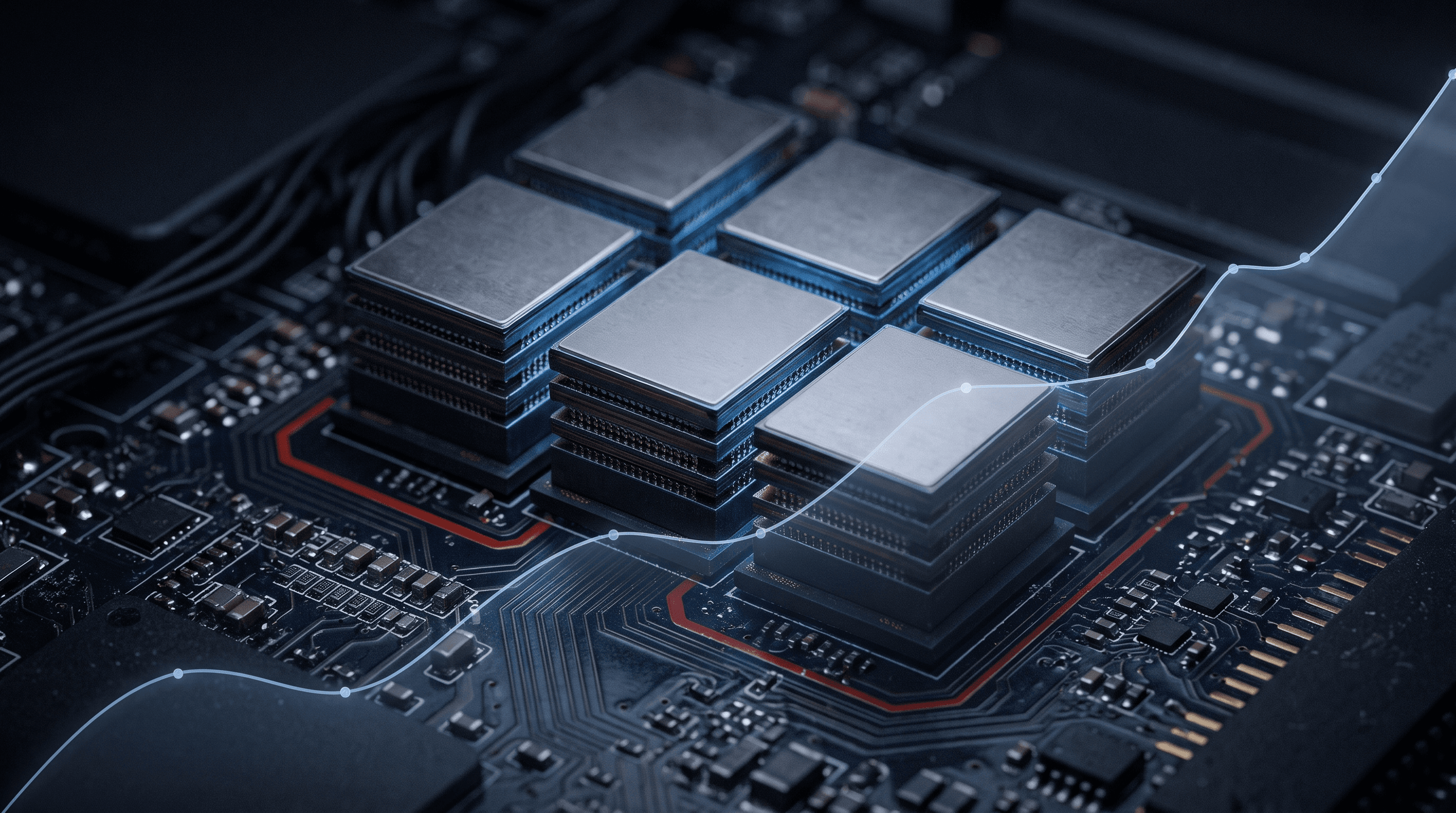
High-bandwidth memory, the specialized chips stacked onto every AI accelerator, is sold out across every major supplier through 2026, now consuming roughly 23% of total DRAM wafer capacity as manufacturers redirect production away from conventional memory (Introl, 2026). Reuters has reported Microsoft, Google, Amazon, and Meta are responding by placing "open-ended orders" with memory suppliers, accepting whatever volume manufacturers can produce regardless of price (Tom's Hardware, 2026).

This part of the AI story doesn't respond to any single company's engineering advantage. Nvidia itself flagged rising component costs as a drag on its own margins this quarter, a dynamic explored in SPXScore's coverage of Nvidia's Q2 earnings and the Korean memory suppliers now capturing that value. Microsoft sits one layer further from the memory itself, but it's no less exposed: every GPU cluster it racks depends on HBM supply it can't manufacture domestically, a vulnerability SPXScore has also examined through U.S. fab policy and tariff exposure.
How Hyperscalers Are Financing the Shortage
What differs across hyperscalers is how each finances its way through the shortage. The Bank for International Settlements pegs off-balance-sheet debt tied to AI buildouts across the five largest U.S. hyperscalers at roughly $1.65 trillion, exceeding the $1.35 trillion those same companies report on their own balance sheets (BIS Quarterly Review, Mar 2026). Microsoft has so far avoided the kind of headline public bond sale that funded Meta's own buildout, leaning instead on joint-venture structures analysts estimate keep much of that leverage at the fund level (Introl, 2026). That's a contrast worth holding up against Oracle's own debt-funded backlog, where free cash flow has already turned negative.
OpenAI, Renegotiated
The other structural shift happened at the contract level. In an April 27, 2026 joint statement, Microsoft and OpenAI announced a restructured partnership that removed Microsoft's exclusivity over OpenAI's models, but extended Microsoft's license through 2032, ended Microsoft's revenue-share payments to OpenAI, and kept OpenAI paying Microsoft a capped share of its own revenue through 2030 (OpenAI, Apr 27, 2026). Microsoft gave up sole-provider status; in exchange, it locked in access on terms that no longer scale against OpenAI's own growth. That's a trade a company confident in its distribution, not just its model access, would make.
Distribution is exactly where Microsoft keeps pressing. More than 20 million paid Microsoft 365 Copilot seats were active as of fiscal 2026 reporting, and OpenAI's models became a subprocessor inside Microsoft 365 itself in August 2026 (CNBC, Apr 29, 2026). Whatever happens to the exclusivity arrangement, Copilot's seat count is a Microsoft asset, sold through Microsoft's own sales motion, running on Microsoft's own cloud. The OpenAI deal changed who Microsoft owes, not who Microsoft sells to.
A Fed That Won't Commit, and a Market Split on the Bill
A Divided Fed and an Inflation Backdrop That Won't Cooperate
Layer the macro backdrop on top and the picture gets less tidy. A divided Federal Reserve left rates unchanged in a 9-3 vote through August, with headline PCE inflation near 4% and core above 3%, while Middle East energy disruptions push oil prices, and inflation expectations, back up (CNN, Aug 11, 2026). J.P. Morgan Wealth Management now expects a 25-basis-point hike at the September 15-16 meeting, though market-implied odds sit close to a coin flip (Chase, 2026), the same uncertainty SPXScore has tracked pushing volatility into equities generally this year. Long-duration growth stocks with cash flows years out, exactly Microsoft's profile, are the most sensitive to which way it breaks.
The Price-Target Spread the Fed Decision Will Settle
| Scenario | Price Target | Basis |
|---|---|---|
| Bear case | $400 | Oppenheimer, citing elevated AI capex and unclear near-term returns |
| Average target | $565 | stockanalysis.com and Public.com analyst forecast aggregation, Aug 2026 |
| Bull case | $870 | High end of the Street range |
| Current price | $507.29 | As of Aug 31, 2026 |
That spread, a $400 bear case from Oppenheimer citing elevated AI capex and unclear near-term returns against an $870 bull case elsewhere on the Street (Investing.com, 2026; stockanalysis.com, Aug 2026), isn't noise. It's a real disagreement over whether Microsoft's depreciation bill catches up to its revenue growth before the Fed decides how expensive money gets from here.
Where the Opportunity Score Fits
This is precisely the kind of disagreement SPXScore's Opportunity Score is built to frame rather than resolve. The score weighs 80% on how far a stock sits below its trailing 52-week high and 20% on trailing PEG valuation, then applies a multiplier between 0.7x and 1.3x based on the trailing 8-week return: a single 0-100 read on how attractive an entry point looks relative to a stock's own recent history, not a forecast of where it goes next.
As of August 31, 2026, MSFT trades at $507.29, just 6.4% off its 52-week high of $542.07, with a trailing PEG of 1.24 (SPXScore Opportunity Score). That combination puts Microsoft's Opportunity Score at 33.3 out of 100, "Neutral," even though its trailing 8-week return was strong enough to max out the score's recovery multiplier at 1.3x. The mechanics are worth sitting with. A stock can be rallying hard and still score as merely average, because the drawdown component carrying 80% of the weight has almost nothing to work with near a 52-week high. Rescaled against just its own trailing six months, MSFT's score falls further, to roughly 18. That's a reminder that "near its highs" and "cheap relative to its own recent range" are different questions. The framework keeps them separate rather than letting momentum paper over valuation. Readers can see the same lens applied across the S&P 500, including the free S&P 50 subset.
Conclusion
None of the three forces reshaping Microsoft this year, the memory shortage, the OpenAI renegotiation, the Fed's indecision, is something the company can out-engineer. What it controls is how it absorbs them: Azure's 43% growth and a $100 billion cloud franchise say the demand side isn't in question; financing discipline next to peers with heavier public debt says management isn't betting the balance sheet to chase it; and an OpenAI deal that traded exclusivity for capped costs says Microsoft is playing a longer game than the next earnings call. The Opportunity Score's read, fairly priced, near its highs, neither a bargain nor obviously stretched, may be the most honest summary available: the AI bet looks like it's working. Whether it was worth the price paid for it is a question the next few Fed meetings, and the next few memory-supply contracts, will keep answering in real time.
More valuation deep-dives
- SK Hynix, Samsung and the KOSPI's 21% Rout: What Peak Buyers Should Do Now
Oct 16, 2026
- Assurant (AIZ) at $266: Back on Sale, but Not a Bargain
Oct 6, 2026
- Netflix at $68: Buy the Dip or a Stock Being Re-Rated for Good?
Oct 2, 2026
- Micron at 7x Earnings: A Buying Opportunity or a Cycle Trap?
Sep 30, 2026
- EchoStar (ECHO): You're Buying SpaceX at a Discount
Sep 22, 2026
- Intel (INTC) Valuation: From Deep Value to a $200 Call
Sep 17, 2026
- Cardinal Health (CAH): Deep Value to Peak Optimism
Sep 14, 2026
- Federal Realty Stock: Is a Near-100 Opportunity Score a Real Buy Signal?
Sep 13, 2026
- Alphabet's $4 Trillion Question: Is Google's AI Story Still Worth the Price?
Sep 9, 2026
- Micron's Wild Ride: From $5.8 Billion Loss to $1.15 Trillion AI Darling
Sep 8, 2026
- Marvell Stock (MRVL): Too Expensive to Buy, or Still Early in the AI Cycle?
Aug 30, 2026
- Meta Stock After the $17 Billion Settlement: Buy, Hold, or Sell?
Aug 27, 2026
- CrowdStrike Round-Tripped From Its Outage Crash. Its Multiple Never Left Peak Optimism.
Aug 26, 2026
- Oracle Stock: When a $638 Billion Backlog Becomes a Balance-Sheet Problem
Aug 25, 2026
- CoreWeave Stock: Between a $104 Billion Backlog and a Debt Bill That Keeps Growing
Aug 24, 2026
- Nvidia Stock (NVDA): From Peak AI Euphoria to Fundamental Reality — Is the 50% Upside Real?
Aug 22, 2026
- Walmart Stock: Priced for Perfection Near $1 Trillion — Is the Premium Justified?
Aug 20, 2026
- Nike Stock: Peak Optimism to a 12-Year Low — Is the Discount Real?
Aug 19, 2026
- Meta Stock: From a $796 Peak to a $200 Billion Lawsuit — Is the Discount Real?
Aug 19, 2026
- Alibaba's Multiple Went From Deep Value to Peak AI Optimism — Then Nearly All the Way Back
Aug 18, 2026
- Intuit's Trailing Multiple Collapsed From 73x to 16x as Wall Street Repriced It for AI Disruption
Aug 17, 2026
- Home Depot's Multiple Went From Deep Value to Peak Optimism — Then Did It Again
Aug 15, 2026
- Analog Devices' Valuation Signal Went Dark in 2024 — Then the Stock Nearly Doubled Anyway
Aug 13, 2026
- Johnson & Johnson's Valuation Took a Round Trip Its Earnings Never Made
Aug 11, 2026