

Micron's Wild Ride: From $5.8 Billion Loss to $1.15 Trillion AI Darling
Micron went from a cyclical trough to a trillion-dollar AI stock in three years, then lost 30% on bubble fears. What the three valuation phases say comes next.
Introduction
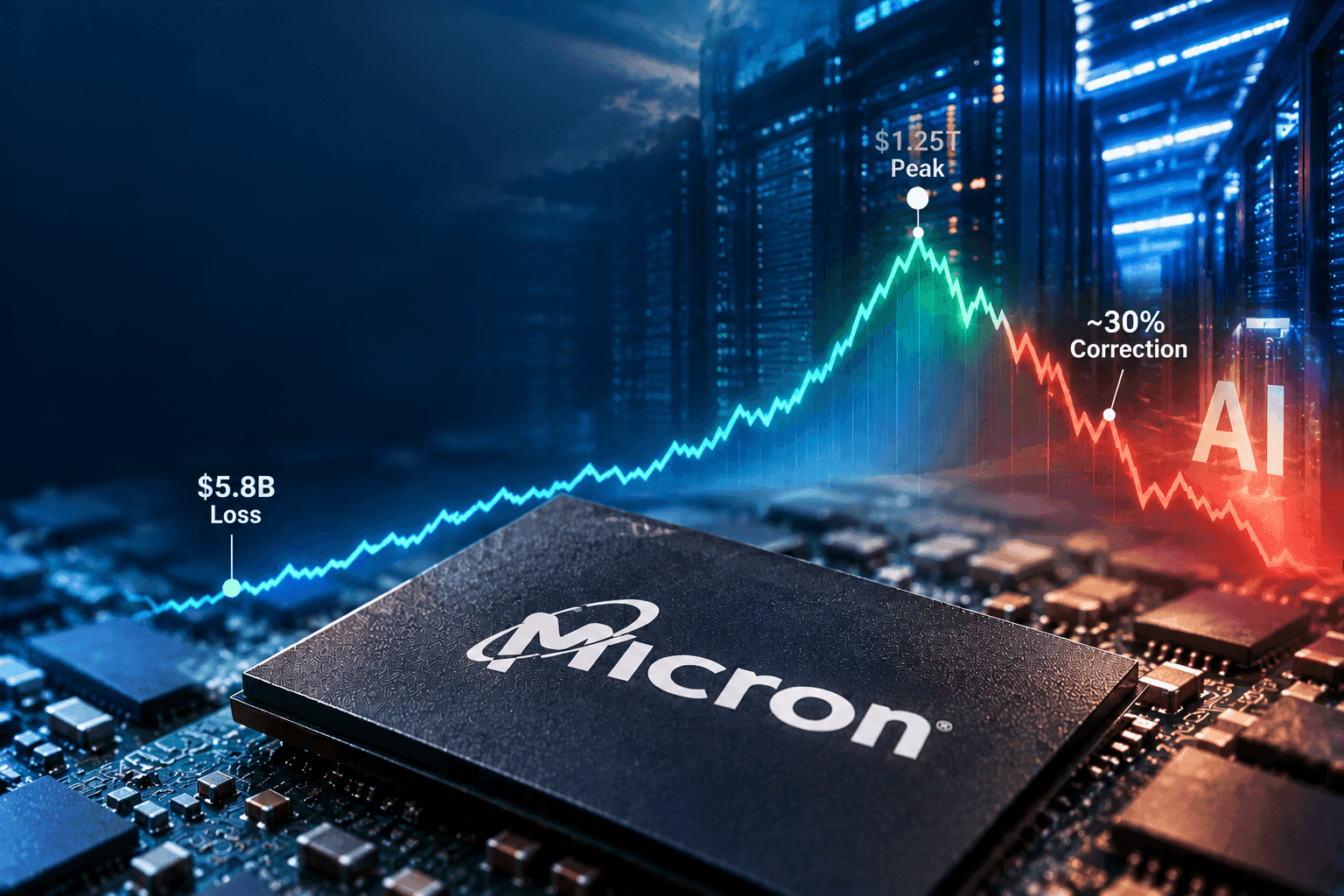
Micron Technology closed at $1,016.59 on September 4, 2026, market cap near $1.15 trillion (stockanalysis.com, Sep 4, 2026). Three years earlier, the same company posted a $5.8 billion annual net loss and a forward earnings multiple in the mid-single digits (Yahoo Finance). In between, Micron opened 2026 near $295 a share and hit an all-time high of $1,255. Then it shed nearly 30% of its value in weeks on fears the AI buildout had outrun itself (The Motley Fool, Jul 19, 2026). Trough, record high, correction: that arc is how Wall Street is pricing artificial intelligence right now, compressed into one ticker.
Key Takeaways
- Forward P/E collapsed to roughly 5-6x in Micron's fiscal 2023 downturn ($5.8B loss, revenue nearly halved to $15.5B). It now sits at 7.07x despite the stock being up almost 700% over the trailing year (stockanalysis.com, Sep 4, 2026).
- Fiscal Q3 2026 revenue hit $41.5 billion (+345% YoY), non-GAAP EPS $25.11; 2026 HBM supply, HBM4 included, is fully sold out, with Micron now guiding the HBM market to $100 billion by 2028, two years earlier than its prior projection (Seeking Alpha, citing Micron's Dec 2025 guidance).
- The stock fell as much as 30% from its $1,255 high on AI-capex-bubble fears, including a single July session that erased ~$138 billion in market value, even as DRAM contract prices kept rising 20-30% QoQ (Fortune, Jul 28, 2026).
- Consensus is Strong Buy across ~48 analysts, zero Sells, average target near $1,513 (~49% upside from the September 4 close). Fiscal Q4 earnings land after market close on September 23, 2026 (stockanalysis.com/forecast).
Phase One: Deep Value in the Wreckage of a Memory Bust
Micron's current valuation only makes sense against where it started. Fiscal 2022 closed with $8.7 billion in net income. Fiscal 2023 flipped to a $5.8 billion net loss, as revenue nearly halved to $15.5 billion and gross margin collapsed from 45% to negative 9% (Yahoo Finance). Pandemic-era over-ordering had left customers sitting on bloated inventories just as demand cooled, and Micron cut capital spending rather than fight the cycle. Forward P/E fell to roughly 5-6x, typical of memory-cycle bottoms. Investors who bought the pessimism, not the earnings, were rewarded later.
Phase Two: The AI-Fueled Recovery
The turn came from an unexpected source: the AI datacenter buildout needed a specific kind of memory Micron made. High Bandwidth Memory (HBM) sits alongside GPUs to feed them data fast enough for AI training and inference, and Micron ramped HBM3E and then HBM4 as hyperscalers raced to lock up supply, the same scramble that drove Nvidia's AI chip earnings and Micron's Asian memory rivals into the spotlight. By fiscal Q1 2026, capex plans rose to roughly $20 billion from $18 billion, aimed at HBM and 1-gamma capacity (Micron Q1 FY2026 earnings call, Dec 2025). Management said it was still meeting only 50-66% of core customer demand (TrendForce, Dec 2025). Micron entered 2026 near $295 a share; by early summer, sold-out HBM capacity had pushed it past $1,000 for the first time.
Phase Three: Peak Optimism, Then a Reality Check
Fiscal Q3 2026 (ended May 28, 2026) is where recovery turned to euphoria: revenue up 345% year over year to $41.5 billion, non-GAAP EPS of $25.11, shares up roughly 14.6% after hours. Management guided fiscal Q4 revenue to a record $50.0 billion, plus or minus $1.0 billion, against a Street consensus of $43.45 billion (StockTitan, Sep 2026).
That pushed Micron to its all-time high of $1,255. It didn't hold. Starting in late June, a broader selloff in AI infrastructure names, on worry that hyperscaler AI capex, which Goldman Sachs' baseline model puts at roughly $765 billion for 2026, sharply above 2025 levels (Goldman Sachs, 2026), had outrun any plausible near-term return, hit chip stocks hard. Micron fell 13% in a single early-July session, erasing about $138 billion of market value. By mid-August, the stock, alongside Samsung and SK Hynix, was down more than 20% from its high, technically a bear market inside a broader AI bull run (Fortune). A more hawkish Fed added pressure on top of that: nine of eighteen policymakers now favor higher rates rather than the cut projected in March, raising the implied cost of debt-funded AI capex (Yahoo Finance, 2026).
What separates this from the 2022-2023 bust: it happened while the business kept improving. DRAM contract prices rose 20-30% quarter over quarter through the same stretch the stock fell (Fortune, Jul 28, 2026), a sentiment-versus-fundamentals gap, not a cyclical top confirmed by weakening demand.
The Multiple Today
A forward P/E of 7.07x on a stock up nearly 700% in a year sounds contradictory until the denominator moves too: forward estimates have been revised up so aggressively on sold-out HBM and rising DRAM pricing that the multiple looks cheap next to Micron's own cyclical-peak history, when it has stretched to 12-15x or higher. The gap shows up in the trailing multiple too: Micron's trailing P/E sits at 22.94x, roughly three times its forward multiple (stockanalysis.com, Sep 4, 2026). Either estimates are still too low and the multiple re-rates higher, or this is a memory-pricing spike that reverses once AI capex cools.
Wall Street: Still Overwhelmingly Bullish
| Analyst / Firm | Date | Rating | Price Target |
|---|---|---|---|
| Pierre Ferragu, New Street Research | Aug 14, 2026 | Upgraded to Buy | $1,250 |
| Deutsche Bank | 2026 (pre-FQ4) | Buy | $1,500 |
| Consensus (~48 analysts) | Sep 2026 | Strong Buy, 0 Sell | ~$1,513 avg. |
Sources: TheStreet; Investing.com; stockanalysis.com/forecast, Sep 2026.
Ferragu argues Micron is breaking its boom-and-bust pattern entirely, modeling a possible $2-3 trillion market cap by 2030. It's an outlier view, but it captures the argument: if HBM demand is structural rather than cyclical, the old playbook, buy the trough, sell the peak, no longer applies.
The Bull Case
HBM's sold-out 2026 supply and the $100 billion 2028 TAM estimate aren't sentiment; they're contracted volume and pricing already locked in. DRAM prices rising 20-30% quarter over quarter through the summer selloff show pricing power held even as the stock didn't. A 49% gap between the current price and the average $1,513 target, with zero Sell ratings among roughly 48 analysts, suggests the Street isn't pricing in a demand collapse, just near-term multiple compression.
The Bear Case
Micron remains a commodity memory maker whose margins live and die on supply discipline across three companies. The roughly $765 billion Wall Street now expects hyperscalers to spend on AI infrastructure in 2026 invites a correction if that pace pauses. A more hawkish Fed compounds that risk by raising the cost of the debt funding much of it.
U.S. export controls on HBM to China have already triggered Chinese retaliation on critical minerals like gallium and germanium. That's part of the same semiconductor tariff exposure rattling the broader chip sector, a geopolitical variable no P/E model captures. A stock that fell 30% once this year on bubble fears can do it again before September 23 even prints.
Conclusion
Micron's three-year arc, from a $5.8 billion loss to a $1.15 trillion company that briefly lost a third of its value on its own success, is the AI trade in miniature: real revenue and contracted demand, priced by a market that can't decide how durable either one is. Strong Buy, average target near $1,513, zero Sells, says Wall Street is betting the HBM supercycle has room to run. The mid-2026 pullback says a slice of the market disagrees, or won't pay peak multiples twice. September 23 is the next test: can Micron ship enough HBM to hit the $50 billion quarter it already guided to.
This article discusses Micron Technology's stock performance, fundamentals, and the broader AI memory market as of September 8, 2026, for informational purposes only. It is not investment advice or a recommendation to buy or sell any security. Stock prices, analyst ratings, and price targets referenced here reflect trading and coverage through approximately September 4-7, 2026; Micron's fiscal fourth-quarter 2026 results are scheduled for release after market close on September 23, 2026, and may materially change the figures, ratings, or outlook discussed above. Readers should confirm current prices, ratings, and financial results against Micron's investor relations site, SEC filings, or a live market data source before acting on any information here. This analysis follows the same forward P/E framework used across every valuation piece on this site.
More valuation deep-dives
- Microsoft's AI Playbook: Record Growth Meets a Chip Squeeze and a Fed That Can't Decide
Sep 2, 2026
- Marvell Stock (MRVL): Too Expensive to Buy, or Still Early in the AI Cycle?
Aug 30, 2026
- Meta Stock After the $17 Billion Settlement: Buy, Hold, or Sell?
Aug 27, 2026
- CrowdStrike Round-Tripped From Its Outage Crash. Its Multiple Never Left Peak Optimism.
Aug 26, 2026
- Oracle Stock: When a $638 Billion Backlog Becomes a Balance-Sheet Problem
Aug 25, 2026
- CoreWeave Stock: Between a $104 Billion Backlog and a Debt Bill That Keeps Growing
Aug 24, 2026
- Nvidia Stock (NVDA): From Peak AI Euphoria to Fundamental Reality — Is the 50% Upside Real?
Aug 22, 2026
- Walmart Stock: Priced for Perfection Near $1 Trillion — Is the Premium Justified?
Aug 20, 2026
- Nike Stock: Peak Optimism to a 12-Year Low — Is the Discount Real?
Aug 19, 2026
- Meta Stock: From a $796 Peak to a $200 Billion Lawsuit — Is the Discount Real?
Aug 19, 2026
- Alibaba's Multiple Went From Deep Value to Peak AI Optimism — Then Nearly All the Way Back
Aug 18, 2026
- Intuit's Trailing Multiple Collapsed From 73x to 16x as Wall Street Repriced It for AI Disruption
Aug 17, 2026
- Home Depot's Multiple Went From Deep Value to Peak Optimism — Then Did It Again
Aug 15, 2026
- Analog Devices' Valuation Signal Went Dark in 2024 — Then the Stock Nearly Doubled Anyway
Aug 13, 2026
- Johnson & Johnson's Valuation Took a Round Trip Its Earnings Never Made
Aug 11, 2026